Tree Service in Livingston, CA
Removals, trimming, pruning, and stump grinding for town lots and surrounding property in Livingston, north of Atwater on Highway 99.
Livingston counted 14,172 residents in the 2020 Census. It is a compact town on Highway 99 with orchards and farmland running right up to its edges, and that setting shapes the tree work more than the size of the town does.
Tree Work on Livingston Properties
Town lots here are generally modest, which puts yard trees close to the things they can damage. A tree that would be unremarkable on half an acre is a different proposition twelve feet from a bedroom wall with a fence on the other side.
Outside the town limits the situation flips. Parcels open up, there is room for equipment to drive right to the tree, and the work shifts toward fence lines, windbreak rows, and trees along field edges rather than trees crowding a house.
The same services apply either way. What changes is how the work gets done and what it costs.
Overgrown and Neglected Trees
A tree that has gone a decade without attention tends to look the same everywhere: long limbs, all the weight out at the ends, a crowded interior, and a canopy spread over whatever is nearby. That end-loaded shape is the one that fails when wind comes up.
Bringing it back means reducing the longest limbs to healthy lateral branches and pulling the deadwood out. It does not mean topping. Cutting main limbs to stubs produces a burst of fast, weakly attached shoots from the cut points, so a few years later the tree is bigger and less stable than before you paid to have it cut. More on both under tree trimming and tree pruning.
Removing Trees Close to Houses and Fences
On a small lot a tree does not get felled, because there is nowhere for it to go. It comes apart from the top: limbs cut and lowered on ropes in pieces small enough to control, then the trunk taken in short lengths.
What tends to catch people out is that the removal itself is often the smaller part of the job. Getting the debris from the back yard to the street is the other part, and on a lot with a narrow side gate that means carrying it. A quote reflects that whether or not anyone mentions it, which is why an inexpensive-sounding number is worth asking questions about. See tree removal and tree removal cost.
Stump Grinding After a Removal
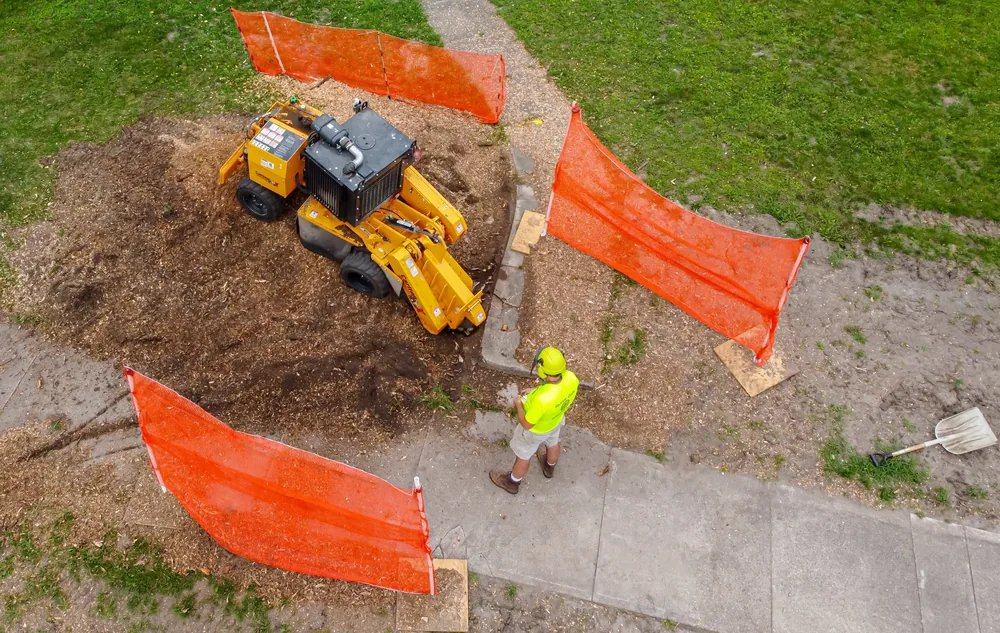
Grinding takes the stump and the main surface roots below grade, usually 8 to 14 inches depending on what the spot is for. Lawn needs enough to get under the root crown. Replanting or paving needs more.
The one thing to settle in advance is whether the stump is in the removal price or quoted separately, because that gap is the most common surprise on a tree invoice. See stump grinding.
Storm and Wind Damage
Winter is when trees come down in this part of the valley, and the sequence matters. Rain first, sometimes for days, which saturates the ground and loosens the soil's grip on the root plate. Wind after, pushing on a canopy the ground can no longer hold.
That combination takes down trees at wind speeds they would have handled easily in dry conditions. A tree already leaning, with soil cracked or lifted on one side of the base, is the one to worry about before the next system arrives. Both situations fall under emergency tree service and hazardous tree removal.
Common Questions from Livingston Property Owners
Do you handle trees on rural parcels outside town?
Yes, and they are often simpler than town lots because equipment can reach the tree directly instead of everything being carried out by hand. Larger parcels also bring brush, fence lines, and volunteer trees into the picture, which is handled as land clearing and priced by area rather than per tree.
Can I keep the wood?
Yes, and it usually lowers the price. Having the trunk left cut into rounds removes the haul and disposal labor from the job. The same goes for chips, which can be left on site for mulch. Say so before the quote is written rather than after, since it changes how the crew plans the day.
How do I know whether a tree should be trimmed or removed?
Look at where the problem is. Branch problems get trimmed: deadwood, overgrowth, clearance. Trunk and root problems point to removal: a hollow or badly decayed trunk, a large crack, fungal growth at the base, or soil lifted on one side. If the trunk is sound and the roots are stable, the tree is usually worth keeping.
What should I ask for in writing?
Which trees exactly, whether stump grinding is included and to what depth, what happens to the wood and the chips, what cleanup covers, and proof of liability insurance and workers compensation. A crew working over your roof without coverage moves that risk onto you, and no discount is worth that.
Tree Work in Livingston?
A photo from the street and a rough height will tell us most of what we need.